Choosing a business structure is one of the important decisions you make when starting or growing a business.
Two common structures used by Australian small businesses are operating as a sole trader and operating through a company.
Both structures can be appropriate in different circumstances, but they have different implications for taxation, liability, administration, costs and future growth.
So, what is the difference between a sole trader and a company?
This guide explains some of the key considerations Australian business owners should understand before choosing or changing their business structure.
What Is a Sole Trader?
A sole trader is generally the simplest form of business structure.
You operate the business as an individual and are personally responsible for the business.
This structure is popular among freelancers, contractors and small business owners because it can be relatively straightforward to establish and administer.
However, the business and the individual are not separate legal entities.
That distinction becomes particularly important when considering liability and taxation.
What Is a Company?
A company is a separate legal entity from its owners.
The company can own assets, enter contracts, incur debts and conduct business in its own name.
Companies also have additional legal, reporting and administrative responsibilities.
Because of these differences, establishing a company can involve more complexity than operating as a sole trader.
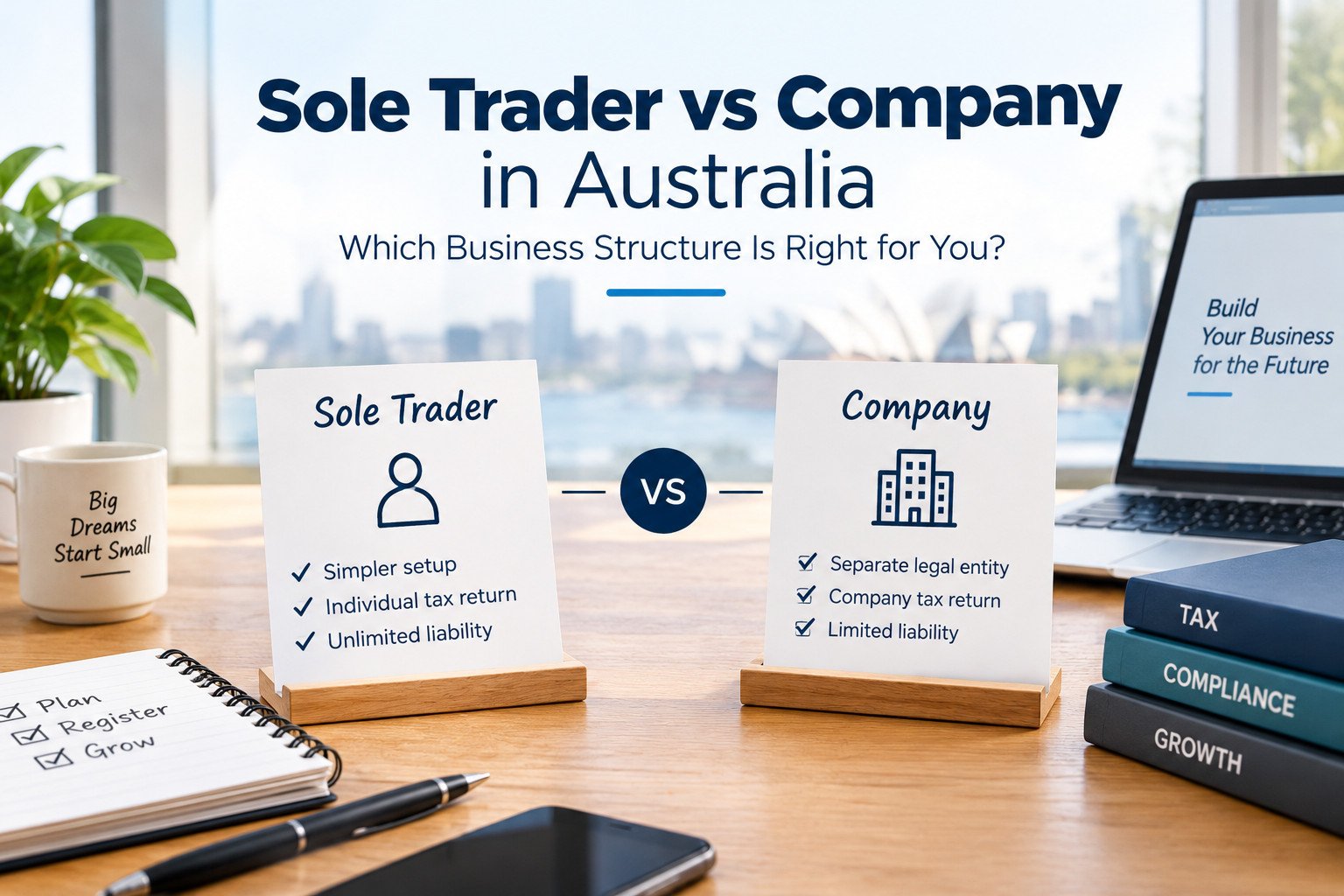
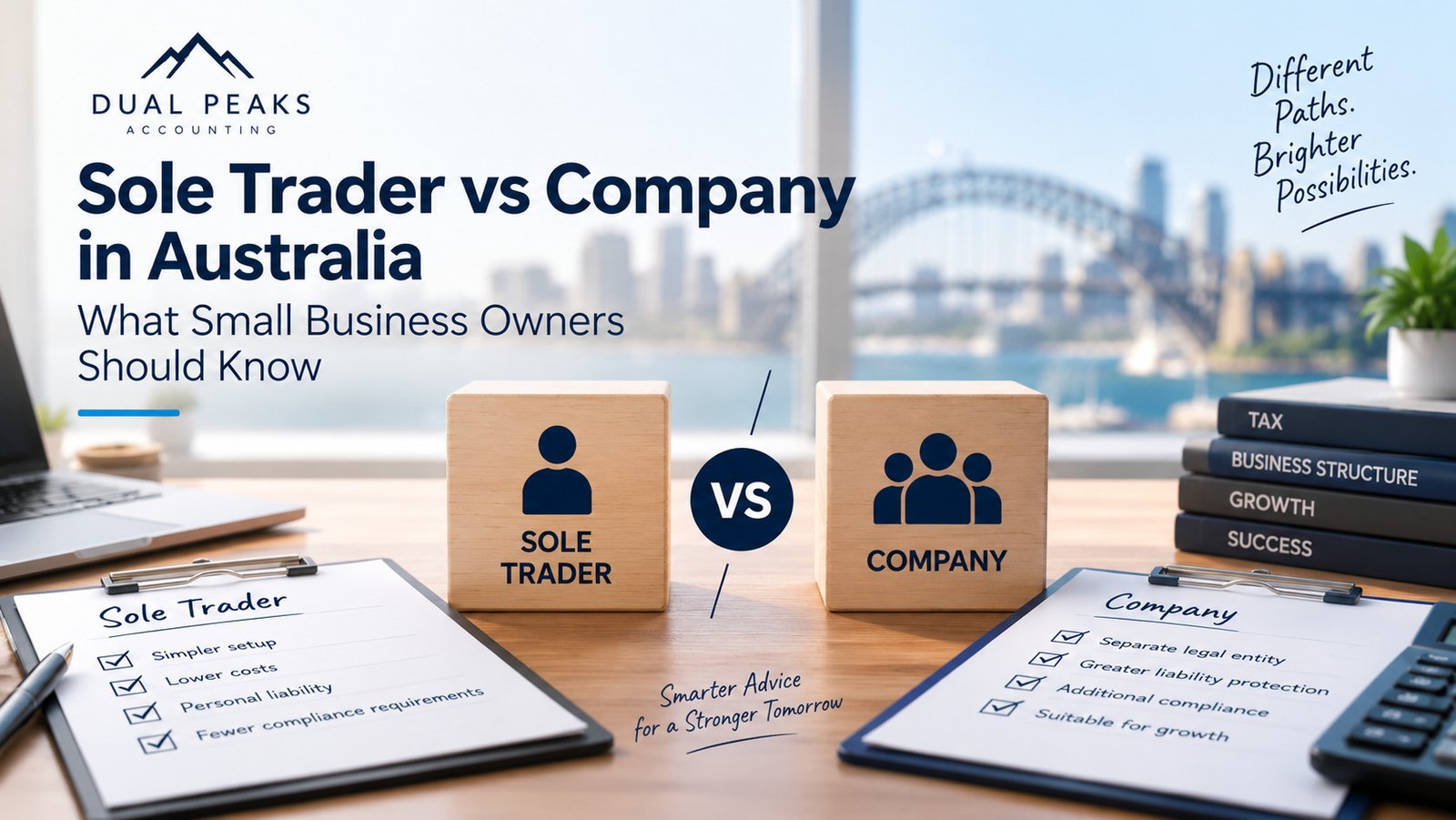
Sole Trader vs Company: Key Differences
1. Legal Structure
As a sole trader, you and the business are legally connected.
With a company, the company is generally treated as a separate legal entity.
This distinction can affect liability, contracts, ownership and other legal responsibilities.
2. Taxation
Tax treatment differs between sole traders and companies.
A sole trader generally reports business income as part of their individual tax return, with tax applying according to the relevant individual income tax rules.
A company generally pays tax on its taxable income under the applicable company tax rules.
However, company money does not automatically become the owner’s personal money.
Payments to directors or shareholders may have their own tax and compliance implications.
For this reason, choosing a company purely because of a particular tax rate can oversimplify the decision.
3. Liability
A sole trader can generally be personally responsible for business debts and liabilities.
A company is a separate legal entity, which can provide a degree of separation between the business and its shareholders.
However, operating through a company does not eliminate every form of personal liability.
Directors have legal responsibilities and may become personally responsible in certain circumstances.
4. Setup and Ongoing Costs
Operating as a sole trader is generally simpler and less expensive from an administrative perspective.
A company normally involves additional establishment and ongoing compliance requirements.
These can include company registration, ASIC obligations, record keeping and additional accounting requirements.
The additional cost needs to be considered against the potential benefits of the structure.
5. Administration
Sole traders generally have fewer administrative requirements.
Companies must maintain appropriate company and financial records and comply with relevant corporate obligations.
As your business grows, these additional systems may become easier to justify.
6. Business Growth
Your future plans should also influence your structure.
If you plan to introduce additional owners, expand significantly, raise capital or build a business that operates separately from you personally, a company structure may provide advantages.
However, the appropriate structure depends on the circumstances of the business.
When Might a Sole Trader Structure Make Sense?
A sole trader structure may suit businesses that:
-
Are relatively simple
-
Have one owner
-
Have limited administrative complexity
-
Are in the early stages of operation
-
Want lower establishment costs
-
Do not currently require a more complex ownership structure
Simplicity is one of the main advantages.
However, business owners should still consider liability, tax and future growth.
When Might a Company Structure Be Considered?
A company may be considered when a business:
-
Is growing significantly
-
Has increasing commercial risk
-
Plans to bring in additional owners
-
Employs a growing team
-
Is generating higher levels of profit
-
Wants greater separation between the owner and business
-
Is preparing for long-term expansion
These factors do not automatically mean a company is the right structure.
They are reasons to review whether your existing structure continues to suit your circumstances.
Can You Change From a Sole Trader to a Company?
Yes, businesses can change structures.
However, changing from a sole trader to a company involves more than simply registering a company name.
Depending on your circumstances, you may need to consider:
-
Business assets
-
Contracts
-
Bank accounts
-
Registrations
-
GST
-
Employees
-
Accounting systems
-
Tax consequences
-
Intellectual property
-
Insurance
-
Existing liabilities
The transition should therefore be planned carefully.
Is a Company Always Better for Tax?
Not necessarily.
Tax is only one part of choosing a business structure.
Your total position may depend on business profit, personal income, how money is withdrawn from the business, future plans and other circumstances.
A structure that works well for one business owner may be inappropriate for another.
Rather than choosing a structure based solely on a headline tax rate, consider the complete financial and commercial picture.
Questions to Ask Before Choosing a Business Structure
Before making a decision, consider:
-
How much revenue and profit does the business generate?
-
What level of commercial risk exists?
-
Will there be additional owners?
-
Do you plan to hire employees?
-
How quickly do you expect the business to grow?
-
Will profits be reinvested?
-
What are the ongoing accounting and compliance costs?
-
Could the business be sold in the future?
-
What are the tax implications for your circumstances?
Answering these questions can help your accountant understand which options should be considered.
When Should You Review Your Business Structure?
Your original structure does not necessarily need to remain your structure forever.
Consider reviewing it when:
-
Revenue or profit increases significantly
-
You hire employees
-
Business risk changes
-
You introduce a business partner
-
You plan significant expansion
-
You acquire substantial assets
-
You are considering selling the business
-
Your personal or financial circumstances change
Regular structure reviews can help ensure your setup remains appropriate as the business evolves.
Final Thoughts
There is no universal winner in the sole trader vs company decision.
A sole trader structure provides simplicity and lower administration, while a company provides a separate legal structure and may be more suitable for certain growing businesses.
The right decision depends on your business, financial circumstances, risk profile and long-term plans.
Thinking About Your Business Structure?
Dual Peaks Accounting helps Sydney business owners understand their accounting, taxation and business structure requirements.
Whether you are starting a new business or considering moving from a sole trader structure to a company, professional advice can help you understand the financial and compliance implications before making the change.
Contact Dual Peaks Accounting to discuss your circumstances.
This article provides general information only and does not constitute personalised tax, financial or legal advice. Business structures can have significant legal and taxation consequences, so obtain professional advice based on your circumstances.