
Hiring help is often a sign that a business is growing. You may need someone to manage customer enquiries, complete projects, support daily operations or provide specialist skills.
Before engaging someone, it is important to understand whether they should be treated as an employee or an independent contractor. Getting the classification wrong can create unexpected costs and compliance problems.
What Is the Difference Between an Employee and a Contractor?
An employee generally works within an employment relationship, while an independent contractor operates their own business and provides services under a commercial arrangement.
However, the distinction is not determined simply by what the agreement calls the worker.
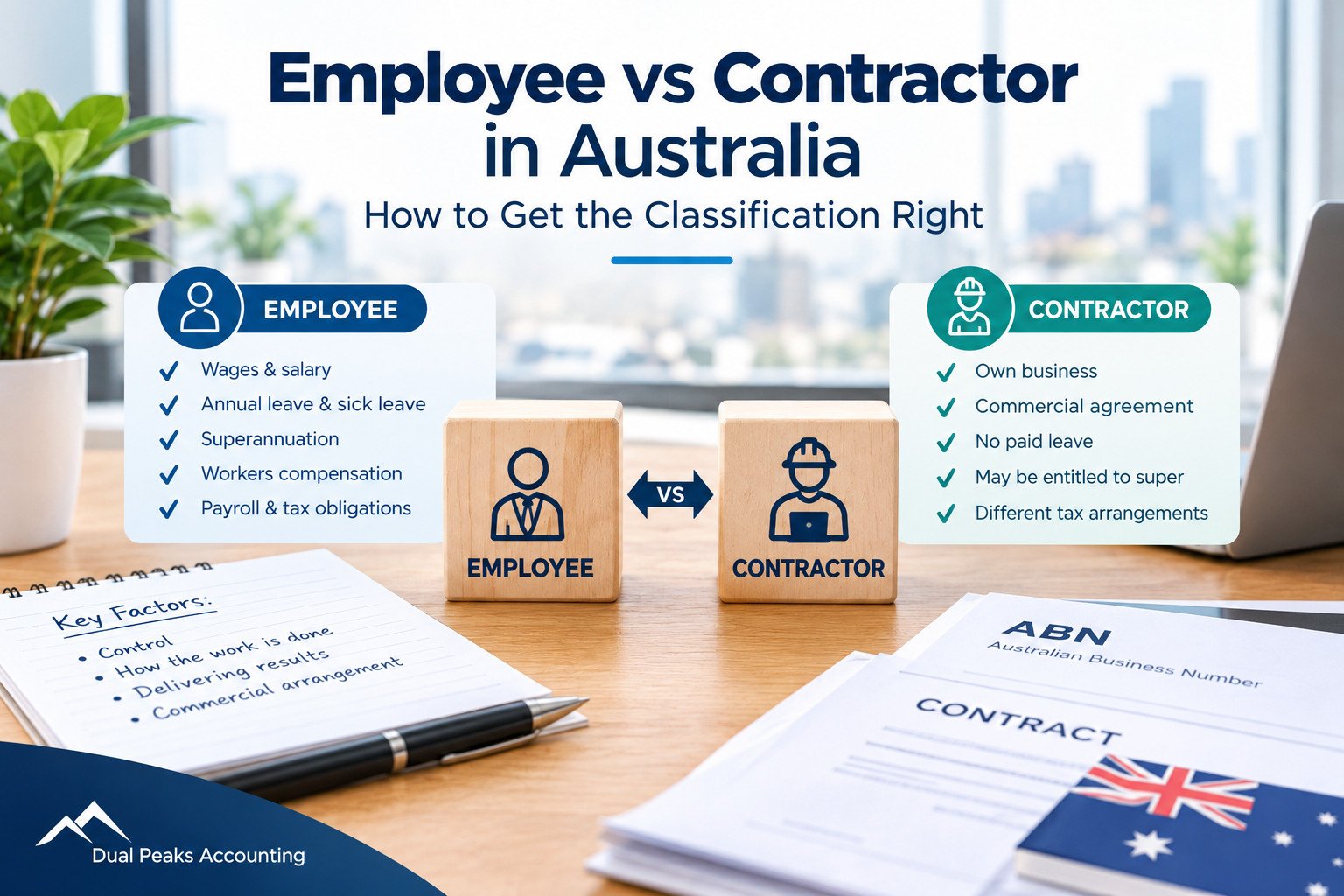
The actual working relationship matters. Factors can include the level of control over the work, the way services are performed, responsibility for delivering results and the commercial arrangements between the parties.
A written contract is useful, but the practical reality of the relationship must also be considered.
Why Does Classification Matter?
The classification can affect a business’s obligations involving wages, leave, superannuation, workers compensation, payroll records and tax reporting.
Employees generally have employment entitlements under applicable workplace laws. Genuine independent contractors typically operate under different commercial arrangements.
Importantly, an independent contractor may still be entitled to superannuation in certain circumstances. For example, some contractors engaged mainly for their personal labour can fall within superannuation rules.
Businesses should not assume that having an ABN or receiving invoices automatically removes their obligations.
Common Classification Mistakes
Treating every ABN holder as a contractor
An Australian Business Number is not proof that a person is an independent contractor. The relationship itself must be assessed.
Relying only on the contract title
Calling someone a contractor in an agreement does not necessarily determine their legal status.
Ignoring how the work changes
A relationship may evolve as responsibilities, working arrangements or commercial conditions change. Businesses should review arrangements when circumstances materially change.
Forgetting record-keeping obligations
Accurate agreements, invoices, payroll records and payment documentation help businesses understand and demonstrate how arrangements operate.
How Can Small Businesses Reduce Risk?
Before engaging a worker, document the proposed arrangement and review the relevant legal and tax requirements. Consider obtaining advice if the relationship has features of both employment and contracting.
If you already engage contractors, review existing agreements and actual working practices. Seek professional guidance where the classification is uncertain.
Final Thoughts
Correct worker classification helps protect your business and supports fair treatment of the people who work with you. A little preparation at the start can help avoid complicated issues later.
Dual Peaks Accounting can assist with payroll records, accounting processes and relevant tax compliance questions.
This article provides general information only. Employment classification can be legally complex. Consult the Fair Work Ombudsman, the ATO or a qualified adviser for your circumstances.