Quick Summary
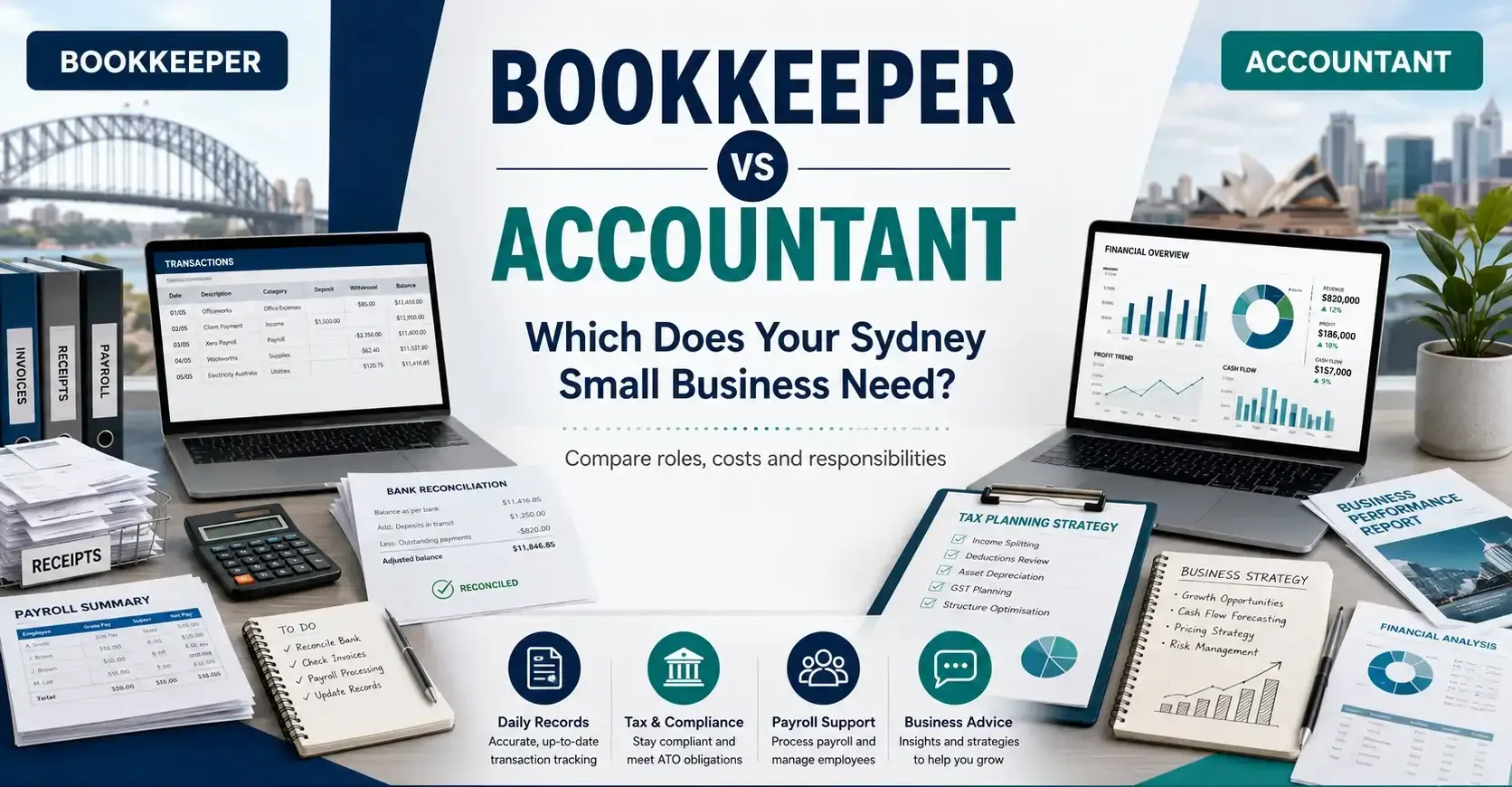
If your main problem is keeping invoices, transactions, payroll and bank reconciliations up to date, you probably need a bookkeeper.
If you need help with tax, financial reporting, business structure, cash flow planning or strategic financial decisions, you are more likely to need an accountant.
Many growing Sydney businesses benefit from using both. The bookkeeper maintains accurate day-to-day financial records, while the accountant uses those records to manage tax, analyse performance and provide higher-level business advice. This broad distinction is also reflected in current Australian accounting guidance.
Bookkeeper vs Accountant: Quick Comparison
| Area | Bookkeeper | Accountant |
|---|---|---|
| Main focus | Day-to-day financial records | Analysis, tax and financial advice |
| Transactions | Yes | Reviews and analyses |
| Bank reconciliation | Yes | May review |
| Invoicing | Yes | Usually not a primary task |
| Accounts payable and receivable | Yes | Usually reviews reporting |
| Payroll | Often | May oversee compliance |
| BAS | Can assist where appropriately registered | Can assist depending on registration |
| Tax returns | Generally not unless appropriately registered | Often, where registered as a tax agent |
| Tax planning | Limited | Yes |
| Financial statements | Basic reports | Preparation and analysis |
| Cash flow advice | Basic monitoring | Forecasting and strategic advice |
| Business structure advice | No | Yes |
| Growth planning | Limited | Yes |
What Is the Real Difference Between a Bookkeeper and an Accountant?
The simplest difference is this:
A bookkeeper keeps your financial information accurate and organised. An accountant interprets that information and helps you make financial, tax and business decisions.
Bookkeeping is focused largely on what is happening in the business each day or month.
Accounting looks at what those numbers mean.
For example, a bookkeeper may reconcile your bank transactions and ensure your expenses are recorded correctly. An accountant may then review the resulting profit and loss statement, identify changes in margins, forecast cash flow and discuss tax implications.
The two roles therefore complement each other rather than compete with each other.
You can also review this bookkeeping vs accounting comparison for a broader explanation of how the two roles differ.
What Does a Bookkeeper Actually Do for a Small Business?
Professional bookkeeping services can help manage the routine financial administration that keeps your records accurate throughout the year.
Typical bookkeeping responsibilities can include:
- Recording and categorising transactions
- Reconciling bank and credit card accounts
- Creating and processing invoices
- Managing supplier bills
- Monitoring accounts receivable
- Monitoring accounts payable
- Maintaining accounting software
- Processing payroll
- Organising financial records
- Preparing routine financial reports
- Assisting with BAS-related work where appropriately registered
This work becomes increasingly important as transaction volume grows.
A business owner may be able to manage ten or twenty transactions comfortably. Managing hundreds of transactions, multiple bank accounts, employees, supplier invoices and customer payments is a very different workload.
Australian guidance from Xero describes bookkeeping as primarily responsible for day-to-day financial record keeping, including transactions, invoices, bank reconciliations and related financial administration.
What Does an Accountant Do That a Bookkeeper Usually Does Not?
An accountant generally works at a higher analytical and advisory level.
Depending on the accountant’s qualifications, registration and engagement, their work may include:
- Preparing financial statements
- Preparing tax returns
- Tax planning
- Reviewing business structures
- Analysing profitability
- Preparing budgets
- Forecasting cash flow
- Reviewing financial performance
- Helping with business finance applications
- Advising on business growth
- Reviewing financial systems
- Managing tax compliance
- Providing business advisory services
An accountant can therefore help answer questions such as:
“Can my business afford to hire another employee?”
“Why is revenue increasing but cash flow getting worse?”
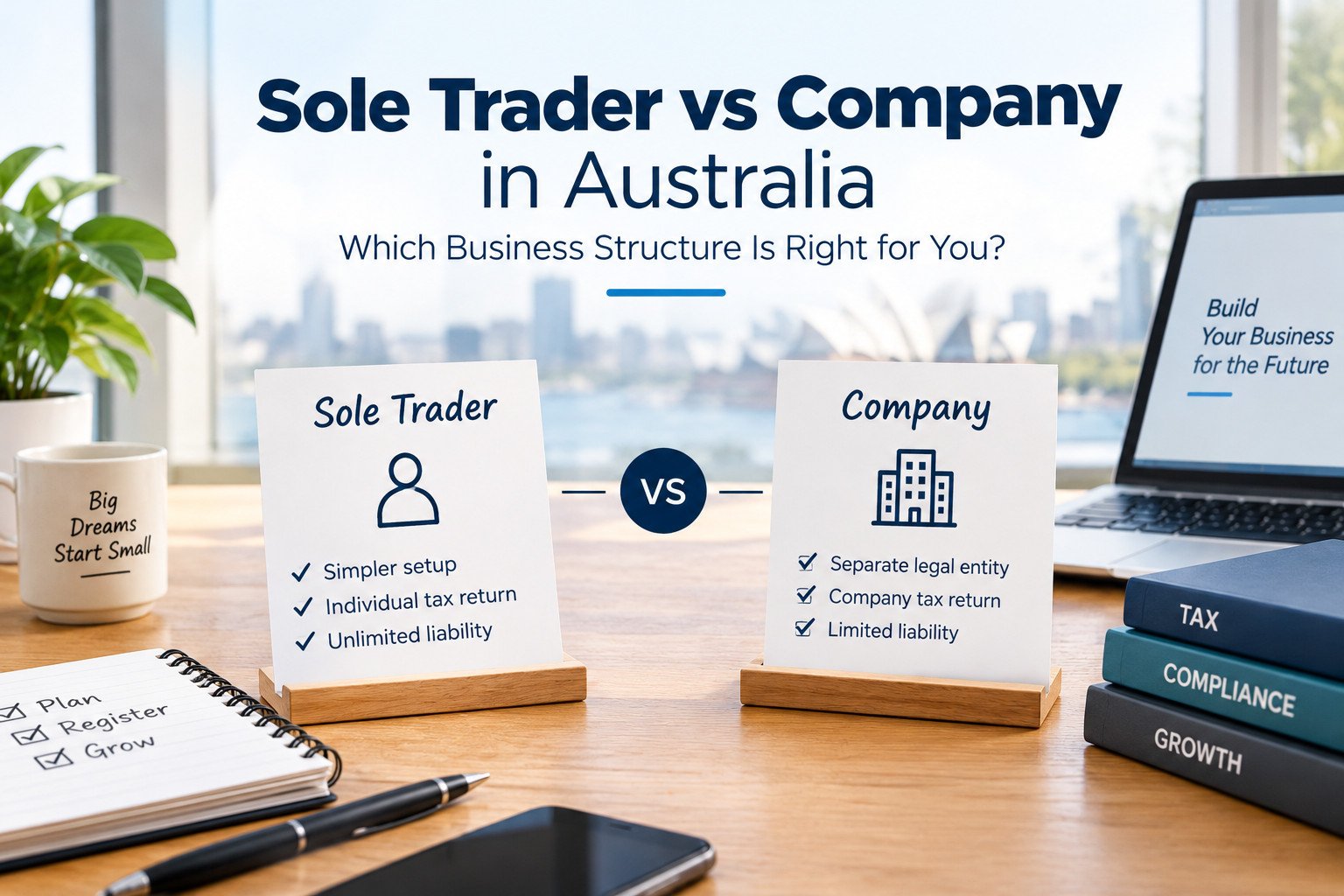
“Should I operate as a sole trader or company?”
“How much should I put aside for upcoming tax obligations?”
“Which parts of my business are actually profitable?”
These questions require more than accurate bookkeeping. They require interpretation of the financial information.
Current Australian guidance describes accountants as using financial records for tax compliance, analysis, financial planning and strategic business advice.
Do I Need a Bookkeeper or Accountant as a Sole Trader?
If you are a sole trader with relatively simple finances, you may not immediately need ongoing bookkeeping support.
You might manage your own routine bookkeeping if:
- You have relatively few monthly transactions
- You do not employ staff
- Your bank accounts are regularly reconciled
- Your invoices are organised
- Your expenses are properly recorded
- Your accounting software is current
You may still benefit from an accountant for your tax return and periodic tax or business advice.
Consider bringing in a bookkeeper when administration starts taking significant time away from your actual business.
Common warning signs include:
- Bank reconciliations are months behind
- You are unsure whether transactions have been coded correctly
- Receipts are missing
- Customer invoices are not being followed up
- BAS preparation becomes stressful
- Your accountant needs to correct the books before starting tax work
Australian businesses are generally required to maintain records supporting their tax affairs, with many business records needing to be retained for five years.
Good bookkeeping therefore helps with more than organisation. It provides the underlying records needed for reporting and compliance.
What If My Small Business Has Employees?
Once employees enter the business, financial administration becomes more demanding.
You may need to manage:
- Payroll calculations
- PAYG withholding
- Single Touch Payroll reporting
- Superannuation
- Employee records
- Payroll reconciliation
- Leave information
- End-of-year payroll finalisation
For growing businesses, this is often where professional bookkeeping and payroll support becomes more valuable.
There has also been an important change for Australian employers.
From 1 July 2026, Payday Super changed the timing of super guarantee payments. Employers now need to pay super in connection with payday, with contributions generally required to reach the employee’s super fund within seven business days after payday, subject to applicable exceptions.
The ATO’s Small Business Superannuation Clearing House also permanently closed from 1 July 2026.
Businesses with employees should therefore make sure their payroll, super and accounting processes are properly coordinated.
Can a Bookkeeper Lodge My BAS?
This is an important distinction.
A person does not automatically need BAS agent registration simply because they perform basic bookkeeping.
However, providing regulated BAS services for a fee generally requires appropriate BAS agent registration.
The TPB states that a person, company or partnership providing BAS services for a fee or other reward must be registered.
That means businesses should check the registration of the professional they engage when the work involves regulated BAS services.
Do not choose a provider purely because they use the title “bookkeeper.”
Ask:
- What services will you perform?
- Are you a registered BAS agent if required?
- Who will prepare and lodge my BAS?
- Who is responsible for checking GST treatment?
- Can I verify your registration?
The Tax Practitioners Board maintains a public register for checking registered practitioners.
How Much Does a Bookkeeper Cost Compared With an Accountant?
Price should be considered alongside the type of work being completed.
As a broad Australian market guide:
| Service | Indicative cost |
|---|---|
| Bookkeeper | Around $40 to $120 per hour |
| Outsourced bookkeeping | Around $500 to $2,500 per month |
| Accountant | Around $150 to $400 per hour |
| Small business accounting | Often fixed-fee or monthly packages |
These are general Australian estimates rather than Dual Peaks Accounting prices.
Xero’s Australian guidance currently places bookkeeping around $40 to $120 per hour and outsourced bookkeeping around $500 to $2,500 per month, depending on transaction volume, experience and scope.
Its accountant guidance notes that accounting fees can commonly range around $150 to $400 per hour, depending on experience, location and complexity.
The important point is that the two professionals should not necessarily be compared on hourly rate alone.
Paying an accountant to perform routine transaction entry may be less efficient than using bookkeeping support for that work and reserving the accountant’s time for tax, analysis and advice.
When Should a Sydney Business Use Both?
For many established small businesses, the most effective arrangement is not choosing between a bookkeeper and accountant.
Combining accounting, bookkeeping and advisory services can allow each financial task to be handled at the appropriate level.
It is allowing both to handle the work suited to their role.
A bookkeeper can manage:
- Monthly transaction processing
- Bank reconciliation
- Accounts payable
- Accounts receivable
- Payroll administration
- Routine bookkeeping reports
An accountant can manage:
- Tax compliance
- Tax planning
- Financial statements
- Cash flow forecasting
- Business structure
- Financial analysis
- Business advisory
- Strategic planning
The bookkeeper helps maintain accurate financial information throughout the year.
The accountant can then work with reliable information instead of spending unnecessary time correcting incomplete records.
Which Option Is Right for My Business?
Use this simple guide.
| Your situation | Likely best option |
|---|---|
| Sole trader with simple records | Accountant for tax, self-managed bookkeeping |
| Sole trader falling behind on records | Bookkeeper plus accountant |
| Small business with regular transactions | Bookkeeper plus accountant |
| Business registered for GST | Bookkeeper or BAS support plus accountant |
| Business with employees | Bookkeeping/payroll support plus accountant |
| Growing company | Bookkeeper plus accountant |
| Business needing tax planning | Accountant |
| Business needing cash flow forecasting | Accountant |
| Business with several entities | Accountant-led support plus bookkeeping |
| Business spending hours every week doing financial admin | Bookkeeper |
Can Accounting Software Replace a Bookkeeper or Accountant?
Software can reduce manual work, but it does not automatically replace professional financial support.
Platforms such as Xero, MYOB and QuickBooks can help businesses:
- Import bank transactions
- Match payments
- Issue invoices
- Track expenses
- Produce reports
- Process payroll
- Store financial information
Cloud accounting solutions can also make it easier for the business owner, bookkeeper and accountant to work from the same financial records.
However, software still depends on correct setup, accurate data and appropriate decisions.https://dualpeaksaccounting.com.au/
A bank feed might import a transaction automatically. It does not necessarily determine why the transaction occurred, whether the coding is appropriate or what financial decision should be made based on it.
Current Xero guidance similarly notes that accounting software can automate routine financial administration but does not replace professional tax, compliance and strategic advice.
What Should I Ask Before Hiring a Bookkeeper or Accountant?
Do not choose only on price.
Ask the following questions first:
- Do you work with businesses similar to mine?
- Which services are included in your fee?
- Do you charge hourly, monthly or by fixed package?
- Which accounting software do you support?
- Who will actually manage my work?
- How often will my accounts be reviewed?
- Are you appropriately registered for the services you provide?
- Can you help as the business grows?
- How will we communicate during the year?
- What work will cost extra?
A good financial relationship should make responsibilities clearer, not more confusing.
Does Dual Peaks Accounting Provide Both Bookkeeping and Accounting Support?
Yes.
Dual Peaks Accounting provides services including bookkeeping, payroll management, tax and compliance, cloud accounting and business advisory support for startups, sole traders and growing businesses in Sydney. The business operates from Roselands, NSW.
This allows a business owner to receive ongoing financial administration and higher-level accounting support without treating each service as an isolated task.
Frequently Asked Questions
Is a bookkeeper cheaper than an accountant?
Usually, yes for routine financial administration. Current Australian guides place bookkeeping fees below higher-level accounting and advisory rates. The final cost depends on complexity, transaction volume and the services included.
Can an accountant also do bookkeeping?
Yes. Accountants can provide or oversee bookkeeping services, although using an accountant for routine data entry may not always be the most cost-effective approach.
Can a bookkeeper prepare tax returns?
Preparing and lodging tax returns for a fee generally requires the appropriate tax-agent registration. Always confirm the practitioner’s registration and scope before engaging them for tax work.
Do I need both if I use Xero?
Possibly. Xero can automate many administrative tasks, but professional judgement may still be needed for tax, compliance, financial analysis and business planning.
When should I hire a bookkeeper?
Consider professional bookkeeping support when financial administration regularly takes time away from running the business, records are falling behind, reconciliations are incomplete or payroll and BAS responsibilities become difficult to manage.
When should I hire an accountant?
An accountant becomes particularly useful when you need tax planning, financial reporting, advice on your business structure, cash flow forecasting, financing support or guidance about growth.
Is a bookkeeper the same as a BAS agent?
Not necessarily. A bookkeeper may perform general bookkeeping without being a registered BAS agent. Providers who perform regulated BAS services for a fee need the appropriate TPB registration.
So, Do You Need a Bookkeeper or an Accountant?
For a simple business with organised records, an accountant may be enough for annual tax and occasional advice.
For a business handling regular invoices, expenses, payroll and growing transaction volumes, bookkeeping support can help keep the financial records accurate throughout the year.
For a growing business, the most practical answer is often both.
The bookkeeper maintains the financial records.
The accountant helps turn those records into better tax, cash flow and business decisions.
Dual Peaks Accounting supports Sydney businesses with bookkeeping, payroll, tax compliance, cloud accounting and business advisory services.
Book a free consultation to discuss your current financial setup and determine which level of accounting or bookkeeping support suits your business.
This article provides general information only and does not constitute tax, financial or legal advice. Pricing examples are indicative market estimates and are not a Dual Peaks Accounting fee schedule.