Quick Summary
How do you find a good tax accountant in Sydney?
Start by checking that the accountant is appropriately registered with the Tax Practitioners Board, then look at their experience with businesses similar to yours, tax planning approach, communication, accounting software knowledge, pricing transparency and ability to assist with ATO matters.
A good accountant should help you understand your obligations, identify legitimate tax opportunities and make better financial decisions. They should not simply prepare a tax return once a year without understanding how your business operates.
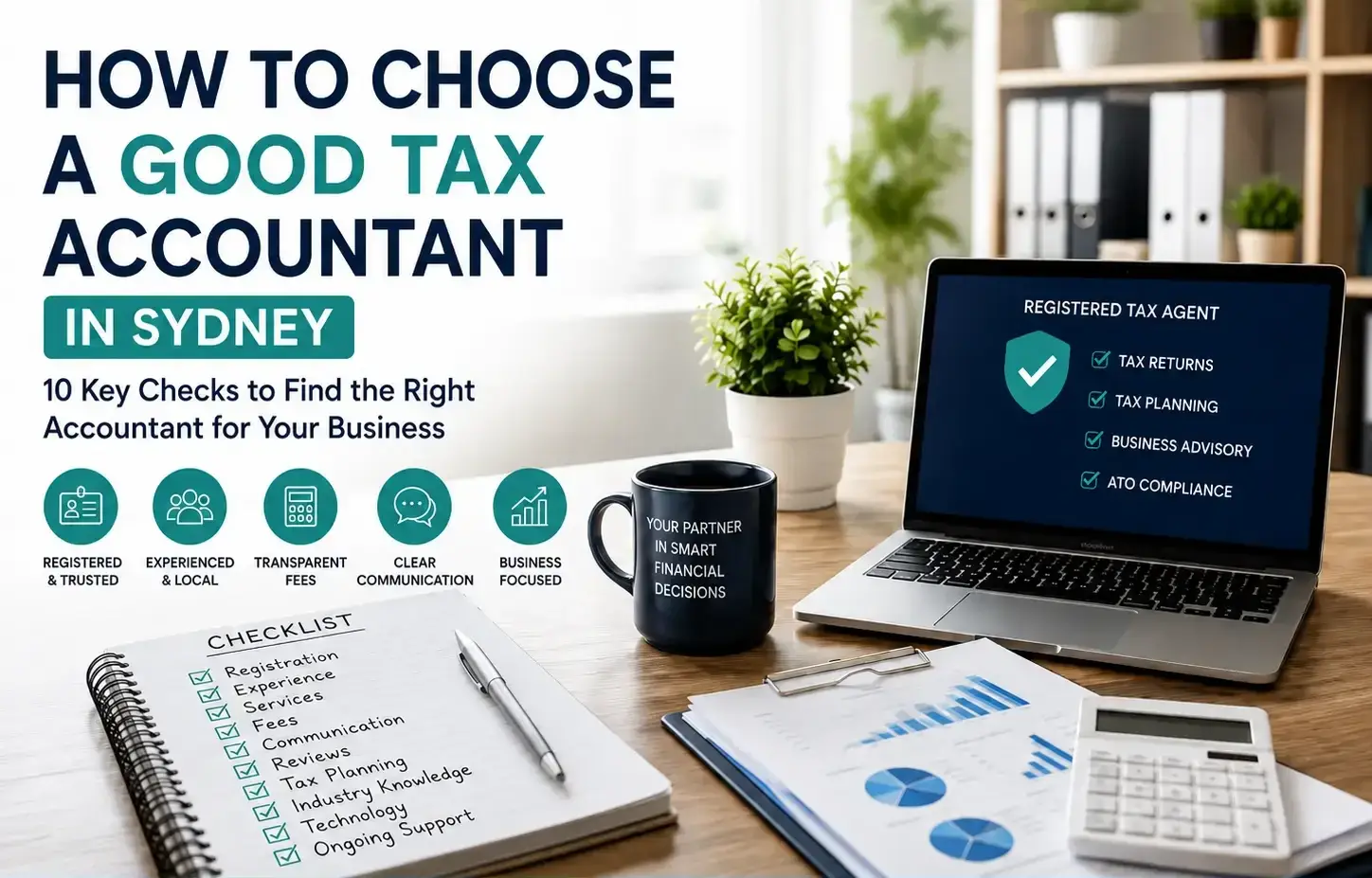
Quick Accountant Checklist
| What to check | What you should look for |
|---|---|
| TPB registration | Current registration for the services you need |
| Business experience | Experience with businesses similar to yours |
| Tax planning | Advice before important decisions and year-end |
| Industry knowledge | Understanding of your sector and financial challenges |
| Software | Experience with Xero, MYOB or QuickBooks |
| Communication | Clear contact person and response expectations |
| Pricing | Written scope, inclusions and exclusions |
| ATO support | Ability to assist with correspondence and tax issues |
| Reviews | Specific, recent and credible feedback |
| Advice | Clear explanations without unrealistic promises |
How Do You Know If a Tax Accountant in Sydney Is Actually Good?
A good tax accountant should meet three basic requirements.
They should be properly registered to provide the services you need, understand businesses similar to yours and offer a level of support that matches your financial situation.
The right accountant for a sole trader with straightforward records may be different from the right accountant for a growing company managing GST, employees, payroll, multiple entities and regular cash flow decisions.
Rather than asking only:
“Who is the cheapest accountant near me?”
Ask:
“Which accountant understands my business and can help me stay compliant while making better financial decisions?”
That question usually leads to a much better choice.
1. Is the Tax Accountant Properly Registered?
This should be your first check.
If you are paying someone to provide regulated tax agent services, check whether they are appropriately registered with the Tax Practitioners Board, or TPB.
The TPB maintains a public register where you can verify registered tax and BAS agents.
Registration matters because registered practitioners are subject to professional conduct requirements relating to matters such as:
- Honesty and integrity
- Competence
- Confidentiality
- Managing conflicts of interest
- Taking reasonable care
- Acting lawfully in clients’ best interests
- Maintaining appropriate professional knowledge
Do not rely only on a logo, business title or statement such as “professional accountant.”
Ask the accountant for their registration details and verify them independently.
Tax Agent vs BAS Agent
The two roles are not identical.
A registered tax agent can generally provide a broader range of taxation services, including income tax advice and tax return preparation, subject to their registration conditions.
A registered BAS agent focuses on BAS-related services such as GST and certain payroll obligations but does not provide the full range of tax agent services.
If you need company tax returns, tax planning or income tax advice, make sure the professional you engage is appropriately authorised for that work.
2. Does the Accountant Regularly Work With Small Businesses?
A tax accountant who mainly prepares individual employee tax returns may not be the best fit for a growing business. Businesses that need broader accounting services for small businesses should also consider bookkeeping, payroll, tax planning and ongoing advisory support.
Ask how much of their work involves:
- Sole traders
- Startups
- Small businesses
- Companies
- Trusts
- GST-registered businesses
- Businesses with employees
- Growing businesses with more complex reporting needs
Small business accounting involves more than completing an annual tax return.
Your accountant may need to understand:
- BAS and GST
- PAYG withholding
- Payroll
- Superannuation
- Business structures
- Cash flow
- Business expenses
- Tax planning
- Financial reports
- Accounting software
- ATO deadlines
The closer their normal client base is to your situation, the easier it should be for them to understand the financial issues your business faces.
3. Does the Accountant Understand Your Industry?
Industry knowledge can make accounting advice more relevant.
Different types of businesses have different financial challenges.
Construction and Trades
Builders and trades businesses may deal with:
- Job costing
- Subcontractors
- Equipment and vehicle expenses
- GST
- Payroll
- Irregular project payments
- Cash flow between jobs
Hospitality
Cafés, restaurants and hospitality businesses may need to monitor:
- Daily sales
- Food and beverage costs
- Payroll
- Casual staff
- Equipment
- Supplier expenses
- Profit margins
E-commerce
Online businesses may have to manage:
- High transaction volumes
- Payment gateways
- Online marketplaces
- Inventory
- Shopify integrations
- GST
- Cloud accounting software
You do not necessarily need an accountant who works exclusively in your industry.
Instead, ask:
“What accounting and tax issues do you regularly see in businesses like mine?”
Their answer should demonstrate practical understanding rather than generic accounting knowledge.
4. Does the Accountant Offer Tax and Compliance Services or Only Tax Returns?
This is one of the biggest differences between basic tax preparation and proactive accounting support.
Tax preparation usually looks backwards.
Tax planning looks forwards.
A tax return records what has already happened during the financial year. Tax planning considers your financial position before important deadlines and decisions.
Depending on your circumstances, proactive discussions may include:
- Estimated tax liabilities
- Business deductions
- Asset purchases
- Cash flow
- Superannuation obligations
- Business structure
- Upcoming payments
- Timing of expenses
- Financial year-end planning
A useful question is:
“When do you normally discuss tax planning with your business clients?”
If the only contact occurs after the financial year has already ended, you may have fewer opportunities to plan ahead.
A good accountant should never promise a particular tax saving before understanding your circumstances.
The objective should be to identify legitimate opportunities while keeping your reporting accurate and supportable.
5. Can the Accountant Work With Your Accounting Software?
Cloud accounting has changed the relationship between accountants and business owners.
Many businesses now use platforms such as:
- Xero
- MYOB
- QuickBooks
Your accountant should ideally be comfortable working with the system your business already uses.
Ask whether they can assist with:
- Bank reconciliation
- GST reporting
- Payroll
- Financial reports
- Chart of accounts
- BAS information
- Software setup
- Accounting integrations
- Reviewing bookkeeping data
Using the same cloud accounting platform can make collaboration easier because the accountant, bookkeeper and business owner can work with consistent financial information.
Dual Peaks Accounting supports businesses using Xero, MYOB and QuickBooks as part of its cloud accounting services.
6. Will You Be Able to Speak to Your Accountant When You Need Help?
Communication should influence your decision just as much as technical knowledge.
Before signing up, ask:
“Who will manage my account and how quickly should I expect a response?”
You should know:
- Who your main contact will be
- Whether communication is by phone, email, video meeting or in person
- Whether routine questions are included
- How additional advice is charged
- Who responds if your normal accountant is unavailable
- How urgent ATO correspondence is handled
You do not need an accountant who responds instantly to every message.
You do need a clear communication process.
Poor communication can become particularly frustrating when a tax deadline, payroll issue or ATO notice requires attention.
7. Are the Accountant’s Fees and Services Clearly Explained?
Do not compare accountants based only on the headline price.
Two accounting quotes can look very different because they may include completely different services.
Common pricing arrangements include:
| Pricing model | Often suitable for |
|---|---|
| Fixed fee | Tax returns or clearly defined accounting work |
| Hourly fee | One-off advice or unusual projects |
| Monthly package | Ongoing accounting, bookkeeping and support |
| Annual package | Recurring compliance and tax planning |
| Advisory arrangement | Growing businesses requiring regular financial guidance |
Before agreeing to a fee, ask exactly what is included.
Possible Inclusions
Your package could include:
- Annual financial statements
- Business tax return
- Company tax return
- BAS preparation
- IAS preparation
- Tax planning
- Bookkeeping review
- Payroll support
- Accounting software assistance
- Scheduled meetings
- Routine ATO correspondence
Possible Exclusions
Additional charges may apply for:
- Historical bookkeeping cleanup
- Amended tax returns
- ATO audits
- Formal objections
- Complex tax advice
- Business restructuring
- Tax debt negotiations
- Additional meetings
- Full bookkeeping
- Software subscriptions
Ask for the scope in writing.
A transparent accountant should be able to explain what you are paying for and what will cost extra.
8. Can the Accountant Help If the ATO Contacts You?
A good business accountant should be able to explain what happens if your business receives correspondence from the Australian Taxation Office.
Ask questions such as:
- Will you review ATO letters for me?
- Can you communicate with the ATO on my behalf where authorised?
- Is routine correspondence included in my accounting package?
- Can you assist with overdue lodgements?
- Can you help with payment arrangements?
- What happens if the ATO reviews my tax return?
- How are complex ATO matters charged?
Do not wait until an ATO issue appears to discover that this type of support is outside your accountant’s normal service.
Changing Accountants
Some Australian businesses changing or appointing registered agents may also need to complete the ATO’s client-to-agent linking process through Online services for business.
Where this process applies, the business completes the nomination.
You should never provide another person with your Digital ID credentials or login code so they can complete this step for you.
9. Are the Accountant’s Reviews Actually Useful?
Reviews can help, but the star rating alone does not tell you everything.
Look for reviews that explain what the accountant actually did.
For example:
“Great accountant.”
provides very little useful information.
A review describing help with:
- BAS
- Business tax
- ATO correspondence
- Payroll
- Tax planning
- Xero
- Starting a business
- Improving reporting
gives you more evidence about the client’s experience.
Look for:
- Recent reviews
- Reviews from business owners
- Specific comments about services
- Consistent feedback about communication
- Independent review platforms
Other useful trust signals may include clearly identified accountants, verified professional credentials, software certifications and detailed service information.
10. Does the Accountant Ask You Enough Questions?
A strong accountant should want to understand your situation before recommending a solution.
During an initial conversation, they may ask about:
- Your business structure
- Annual turnover
- GST registration
- Employees
- Payroll
- Accounting software
- Bookkeeping condition
- Previous tax returns
- Outstanding ATO obligations
- Business goals
- Cash flow
- Other entities or trusts
Be cautious when someone immediately recommends a tax strategy without understanding your circumstances.
Tax advice depends on facts.
An accountant who asks thoughtful questions is more likely to understand those facts before giving advice.
What Questions Should You Ask Before Hiring a Tax Accountant?
Use these questions when speaking with prospective accountants:
- Are you appropriately registered with the Tax Practitioners Board?
- Do you regularly work with small businesses like mine?
- What experience do you have with my industry?
- Do you work with Xero, MYOB or QuickBooks?
- Do you provide tax planning before the end of the financial year?
- What services are included in your fee?
- Which services cost extra?
- Who will manage my account?
- How quickly do you normally respond to questions?
- What would you review first if you became my accountant?
The last question is particularly useful.
A thoughtful accountant may want to review your business structure, bookkeeping, tax position, BAS, payroll and financial reports before recommending changes.
What Are the Red Flags When Choosing a Tax Accountant?
Be cautious if you notice any of the following.
Registration Cannot Be Verified
Do not proceed with regulated tax services until you have confirmed appropriate registration.
Guaranteed Tax Refunds or Savings
No accountant can responsibly guarantee a particular tax outcome without reviewing your circumstances.
Questionable Deductions
Be cautious if someone recommends deductions without asking about evidence, business purpose or supporting records.
No Written Scope
You should understand what work is included before engaging the accountant.
Extremely Cheap Pricing With No Explanation
A low price is not automatically bad, but you need to know what the service includes.
Poor Communication Before You Become a Client
If it is already difficult to get clear answers during the enquiry stage, consider whether that communication style will work for you long term.
Requests for Your Digital ID Login
Do not share your personal Digital ID credentials or authentication codes.
No Interest in Your Business
A business accountant should understand more than the figures appearing on last year’s tax return.
Is a Local Sydney Accountant Better Than an Online Accountant?
Not necessarily.
A local accountant can be valuable when you prefer:
- Face-to-face meetings
- Local accessibility
- A nearby office
- A relationship with a local business adviser
An online accountant may work well when:
- Your business already uses cloud accounting
- You prefer video meetings
- Your records are digital
- Geographic location is less important than specialist expertise
The best option depends on your preferences.
Dual Peaks Accounting operates from Roselands, Sydney, while cloud accounting allows support to be provided to businesses across a wider area.
For businesses in Roselands, Bankstown, Campsie and surrounding Sydney suburbs, local access can provide the convenience of an accountant nearby while still supporting modern online accounting processes.
When Should You Consider Changing Accountants?
You may want to reconsider your current accounting relationship when:
- You rarely hear from your accountant
- Tax planning never happens before year-end
- Emails repeatedly go unanswered
- You do not understand what you are paying for
- Financial reports are never explained
- Your business has grown beyond the accountant’s capabilities
- Your industry has become more complex
- Your accounting software is not being used effectively
- ATO deadlines are regularly stressful
- You want more business advice than your accountant currently provides
Changing accountants does not necessarily mean your current accountant has done something wrong.
Your business may simply have outgrown the level of service you originally needed.
Frequently Asked Questions
How do I find a good tax accountant in Sydney?
Start by verifying appropriate TPB registration. Then compare business experience, tax planning, fees, communication, accounting software skills and ATO support. Choose the accountant who best fits your business rather than simply selecting the lowest quote.
How can I check whether a tax accountant is legitimate?
Search the Tax Practitioners Board Public Register and verify that the accountant or accounting entity has current registration appropriate for the tax services you need.
Should my small business use a tax accountant?
Professional accounting support can be valuable when your business has GST obligations, employees, multiple entities, complex deductions, regular BAS reporting or a need for tax planning and financial advice.
Is the cheapest tax accountant a good choice?
Possibly, but price should not be considered alone. Compare the scope of work, qualifications, communication and ongoing support included in each quote.
Should my accountant know Xero?
If your business uses Xero regularly, choosing an accountant familiar with Xero can make bookkeeping reviews, financial reporting, GST and collaboration easier. The same principle applies to MYOB and QuickBooks.
How often should I speak with my accountant?
The right frequency depends on your business. A simple sole trader may need occasional meetings, while a growing business may benefit from monthly or quarterly financial reviews.
Can a tax accountant guarantee that I will pay less tax?
No responsible accountant should guarantee a particular tax saving before reviewing your circumstances. Their role is to identify legitimate tax opportunities and help you comply with Australian tax requirements.
Do I need a local accountant in Sydney?
Not necessarily. Cloud accounting allows businesses to work effectively with accountants remotely. However, a local accountant can be useful when you prefer in-person meetings or want easy access to a nearby adviser.
Ready to Choose the Right Accountant for Your Business?
Choosing a good tax accountant in Sydney is not about finding the biggest refund promise or the cheapest tax return.
Look for someone who:
- Is properly registered
- Understands your business
- Communicates clearly
- Provides transparent pricing
- Uses modern accounting systems
- Plans ahead
- Can support you as the business grows
Dual Peaks Accounting provides tax and compliance, bookkeeping, payroll, cloud accounting and business advisory services for startups, sole traders and growing businesses in Sydney.
Looking for a tax accountant in Sydney who can support more than your annual tax return?
Book a consultation to discuss your business structure, tax obligations and current accounting requirements.
This article provides general information only and does not constitute personalised tax, financial or legal advice. Tax requirements and outcomes depend on individual circumstances and applicable Australian law.